Found Connections is an augmented reality installation that let’s you rediscover the character’s from the ABC television series ‘Lost’. It’s part of the ITP Winter Show, this Sunday 2-6pm and Monday 5-9pm.
Click here to find out more!

Found Connections is an augmented reality installation that let’s you rediscover the character’s from the ABC television series ‘Lost’. It’s part of the ITP Winter Show, this Sunday 2-6pm and Monday 5-9pm.
Click here to find out more!

Elevator pitch:
LOST: Connections
Lost: Connections is an interactive exploration of the characters and storylines of the television show Lost. It will provide a new, spatial way to experience the relationships and narrative of the show by mapping the many connections between the characters and allowing the audience to interact with them in a non-linear way. Through both a two-dimensional and three-dimensional cartography of the island, new sensations and a deeper understanding of the show’s complex story arc and characters can be revealed. A map of the character’s connections will be presented in a two dimensional plane; moving and interacting with the map will reveal the scenes in a three-dimensional environment that is projected in front of the audience.
Here’s a link to my spatial design portfolio
This is a proto-prototype of my LOST connections labyrinth (as in the ABC tv series). The get a sense of what it would be like, follow these directions (or don’t and watch it break on you!)
1) click on the island.
2) Click on the connection types in the right hand corner to see the different paths between characters
3) Click on “coincidental connections” last.
4) click on sawyer
5) click on the image that appears. Enjoy the show.
6) Click on Jack. repeat step 5.
6.5) Click on “trial-by-island’
7) click on jack again.
8) repeat step 5.
9) click on Locke to start over


It seems that one of Rodchenko’s (many) gifts was his ability to conceptualize with a sense that his structures could vary greatly in their size. From some of the photographs, it becomes an optical trick to determine how big a structure actually is.
I was reminded especially of artists like Mark di Suvero’s works at the Storm King art center in mountainville, ny. You get a sense of this idea scale in great effect; in an expansive outdoor space you can view structures from so far away that they are almost like toys, but you also can interact with them in their monumental reality.
(images from storm king, august 30 2003//click an image to enlarge)
Saw this link on we make money not art:
DYTE.
Dynamic terrain is ‘a dynamic architectonic surface.” Essentially it’s a computer controlled 3D landscape architected in the real world.
It’s a little creepy and a little cool!
Check it out…
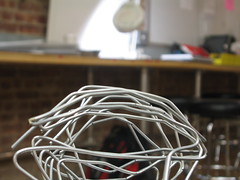
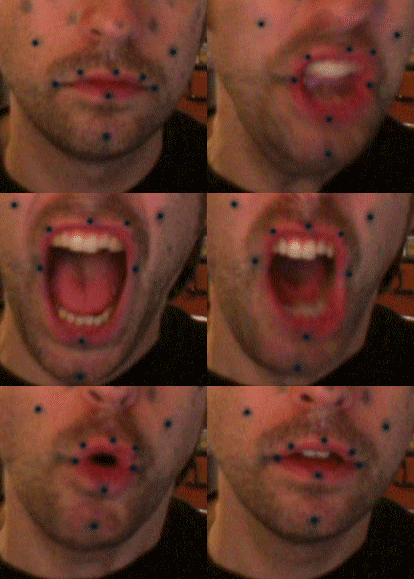
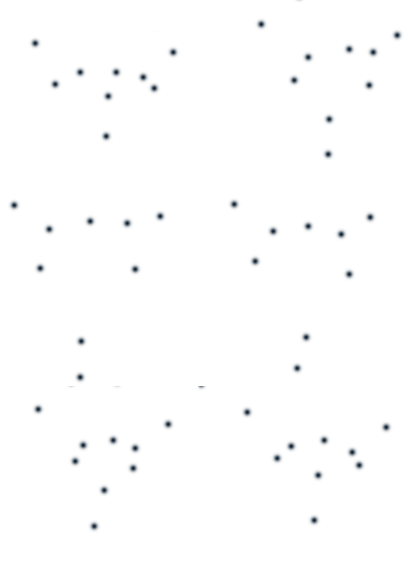
here’s a photoset of a structure I built using the data from last week’s motion tracking exercise. The points of motion are from my mouth, saying “no!” I then converted those points into a literal wireframe, to create this structure.
Source material for this weeks spatial design project:
and